Curating Data, Fermenting Ecologies
Workshop by Magdalena Tyżlik-Carver
Please note: If you'd like to participate in the workshop we kindly ask you to send an email to jonas.vonlenthe@fhnw.ch with a short rationale outlining your background and motivation to participate. Accepted participants will be informed by October 5.
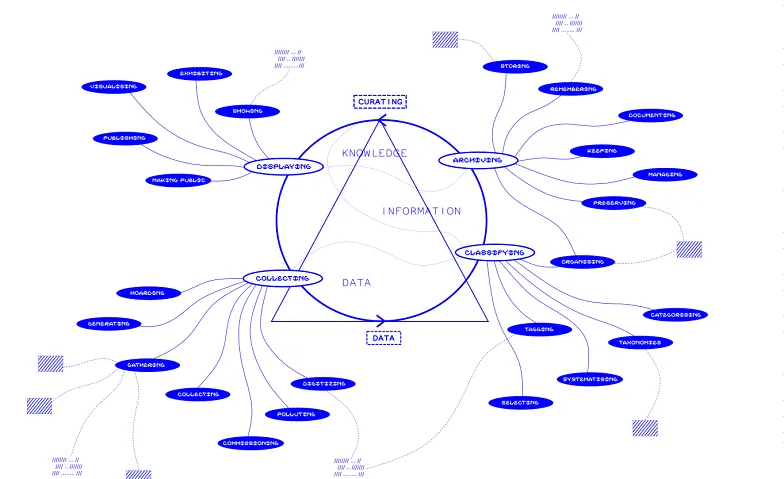
Working with diagrams is to hold things open to many possible interpretations. This workshops start from the Curating Data diagram, a way of mapping curatorial operations such as collecting, classifying, archiving and displaying as relations that never quite settle. Diagramming practice lets us navigate between differently sourced and attributed readings of the same thing, rather than settling on one, seemingly preferred answer or description. Curating Data diagram treats this non-closure as affordance not a problem to fix. We will test this process by starting from a jar of ferments that are alive and changing. We will trace what’s in the jar and what surrounds it: the hands holding it, tastes of it, microbes transforming it. And we will see how open and legible can the diagram stay.
Magdalena Tyżlik-Carver is Associate Professor of Digital Communication and Culture in the Dept. of Digital Design and Information Studies, and co-Director of the Centre
...
afficher plus
Curating Data, Fermenting Ecologies
Workshop by Magdalena Tyżlik-Carver
Please note: If you'd like to participate in the workshop we kindly ask you to send an email to jonas.vonlenthe@fhnw.ch with a short rationale outlining your background and motivation to participate. Accepted participants will be informed by October 5.
Working with diagrams is to hold things open to many possible interpretations. This workshops start from the Curating Data diagram, a way of mapping curatorial operations such as collecting, classifying, archiving and displaying as relations that never quite settle. Diagramming practice lets us navigate between differently sourced and attributed readings of the same thing, rather than settling on one, seemingly preferred answer or description. Curating Data diagram treats this non-closure as affordance not a problem to fix. We will test this process by starting from a jar of ferments that are alive and changing. We will trace what’s in the jar and what surrounds it: the hands holding it, tastes of it, microbes transforming it. And we will see how open and legible can the diagram stay.
Magdalena Tyżlik-Carver is Associate Professor of Digital Communication and Culture in the Dept. of Digital Design and Information Studies, and co-Director of the Centre for Critical Data Practices, both at Aarhus University. She works with the concept of posthuman curating to inquire into computational and data cultures. Currently her focus is on the digital transformation in knowledge making practices driven by AI technologies, semantic web, and data infrastructures. As a curator and researcher she develops participatory methods for data practices beyond BigTech extractivism and expansive infrastructural politics by working with speculative methods and open data principles (Fermenting Data, common practice), as well as knowledge graphs, diagrams and guides (Curating Data). As an independent curator she curated exhibitions and events including: Fermenting Data: Aaarhus 8000-8220 (2021), ScreenShots: Desire and Automated Image (2019), and Movement Code Notation (2018). She is co-editor of Curating Superintelligences. A Reader on AI and Future Curating (2025) and Executing Practices (2018), both published by Open Humanities Press in Data Browser series. She is also co-author of Boundary Images (2023), published by Minnesota Unviersity Press. She regularly writes about digital and visual cultures with focus on digital images and curating, contributing to edited collections, journals and magazines.
The workshop is part of Non-Public Publics, a series of events organized by Make/Sense Research and the Institute Experimental Design and Media Cultures (IXDM) at FHNW Basel, and is embedded in the program of the MESH festival 2026.
afficher moins