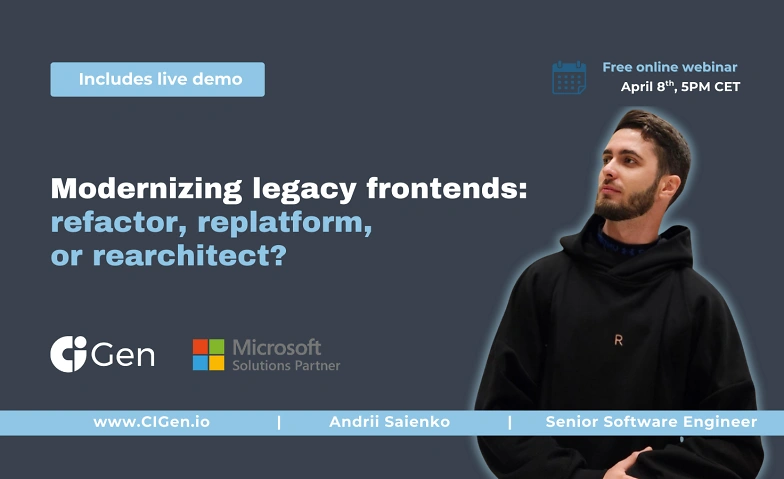
Legacy frontends often evolve over many years, accumulating technical debt, architectural constraints, and delivery friction. At some point, teams face a strategic decision: should the application be refactored, migrated to a modern framework, or redesigned architecturally?
This webinar explores practical approaches to frontend modernization, helping engineering teams evaluate when incremental improvement is sufficient and when deeper architectural changes are required. Using real-world architectural patterns and decision frameworks, we will examine how to assess the current state of a frontend system and determine the most appropriate modernization path.
What we will cover
1. Assess the current state
Understand how to evaluate legacy frontend systems by reviewing technical debt signals, framework lifecycle risks, performance limitations, and alignment with business goals
2. Refactor for code quality and maintainability
Explore scenarios where incremental refactoring can improve modularity, reduce coupling, and increase delivery velocity without requiring major architectural changes.
3. Replatform to modern frontend ecosystems
Learn when migrating to modern frameworks or runtimes can improve performance, maintainability, and long-term support while preserving
...
mehr anzeigen
Legacy frontends often evolve over many years, accumulating technical debt, architectural constraints, and delivery friction. At some point, teams face a strategic decision: should the application be refactored, migrated to a modern framework, or redesigned architecturally?
This webinar explores practical approaches to frontend modernization, helping engineering teams evaluate when incremental improvement is sufficient and when deeper architectural changes are required. Using real-world architectural patterns and decision frameworks, we will examine how to assess the current state of a frontend system and determine the most appropriate modernization path.
What we will cover
1. Assess the current state
Understand how to evaluate legacy frontend systems by reviewing technical debt signals, framework lifecycle risks, performance limitations, and alignment with business goals
2. Refactor for code quality and maintainability
Explore scenarios where incremental refactoring can improve modularity, reduce coupling, and increase delivery velocity without requiring major architectural changes.
3. Replatform to modern frontend ecosystems
Learn when migrating to modern frameworks or runtimes can improve performance, maintainability, and long-term support while preserving existing application functionality.
4. Rearchitect for scalability and micro-frontend readiness
Examine architectural approaches such as domain-driven frontend structures and micro-frontend patterns that enable teams to scale development across multiple domains.
5. Balance risk, cost, and time-to-value
Understand how engineering effort, operational risk, and business priorities influence the decision between refactoring, replatforming, and full architectural redesign.
Who should attend
This session is relevant for:
- Software architects
- Frontend engineering leaders
- CTOs and technical decision-makers
- Product teams responsible for legacy applications
What you will gain
Participants will gain a clearer understanding of:
- How to evaluate the modernization readiness of legacy frontend systems
- When to choose refactor vs replatform vs rearchitect
- Architectural patterns that support long-term frontend scalability
- Practical considerations when planning modernization initiatives
The event is organized by CIGen, a company providing app modernization services as the core offering on Azure.
weniger anzeigen